the one who walks with you


published on marychasewrites.substack.com
In the last few years, I’ve had the opportunity to deliver a keynote address to Chi Sigma Iota chapter initiation ceremonies at the University of North Georgia, the University of Mississippi, and Georgia State University. For anyone reading this who is not a professional counselor, Chi Sigma Iota Counseling Academic and Professional Honor Society International is one of the largest professional organizations for counselors, with chapters across the world. Chi Sigma Iota, or CSI, is all about the pursuit of excellence in counseling and was a big part of my life for a decade. I was a student member, then president of my chapter, and most recently as a professional member, the editor of the Chi Sigma Iota Exemplar.
This summer was a culmination of deep transformation in my professional life. The person I was when I first joined CSI looks nothing like the person who I imagined becoming at that time, and the person I imagined becoming at that time looks nothing like who I am today.
The keynote address was mostly the same across each event. Looking back, I think I was able to capture what I love the most about my job. This has been an anchor in the seas of my own transformation. Ironically, the original title was called “Anchors in the Thresholds: Counselors in Liminal Spaces.”
I’m calling this, a keynote-turned-essay, “The One Who Walks With You”. The title is based on a translation of the Scots Gaelic word “co-choisitche,” a spiritual companion in Scottish folklore, which I am only able to verify based on one book I read and a mediocre Google search. I’m only on level 6 of Scots Gaelic in Duolingo.
The One Who Walks With You
I spend a lot of my time as a counselor and counselor educator talking about crisis intervention, suicide prevention, aging, grief, bereavement, death anxiety, and death. I’m very fun at parties.
But in all seriousness, becoming a professional counselor has enabled me to spend a lot of time in liminal spaces, and that’s what I want to write about today.
But first: Who is a counselor?
Here’s a definition I like, based on the American Counseling Association and the Council for Accreditation of Counseling and Related Educational Programs:
Counselors are trained professionals who engage in a professional relationship to empower diverse individuals, families, and groups accomplish mental health, education, and career goals.
It takes a lot of effort to be here, to do this work. I truly believe when you become a professional counselor, you unlock a level of your humanity you’ve never accessed before. I truly feel like when you become a counselor, you level up your humanity.
(For the record, I included an image on my slides that says NEW ACHIEVEMENT! in the style of Dungeon Crawler Carl by Matt Dinniman, but no one across three keynotes understood my reference).
I think leveling up humanity happens in many ways.
By being a compassionate witness to the deepest grief and the greatest joy.
By being a grounding presence for someone during the worst time of their life.
By sitting with vulnerable people in vulnerable places.
By challenging systems that no longer work and having courage to change them.
And by getting comfortable dwelling in lots of liminal spaces.
So what’s a liminal space?
A liminal space is the uncertain transition between where you’ve been and where you’re going – physically, emotionally, or metaphorically.
I have an example to show you. This is the bridge between the parking deck and the main hospital just down the road at Baptist Memorial Hospital in Memphis, Tennessee. This is where I was born, where my mom almost died about 5 weeks after my son was born, where my niece was born, and where, in this picture, I was on my way to visit my uncle. I remember taking this picture and not fully knowing what I was walking into. It turned out to be the beginning of the end of his life.
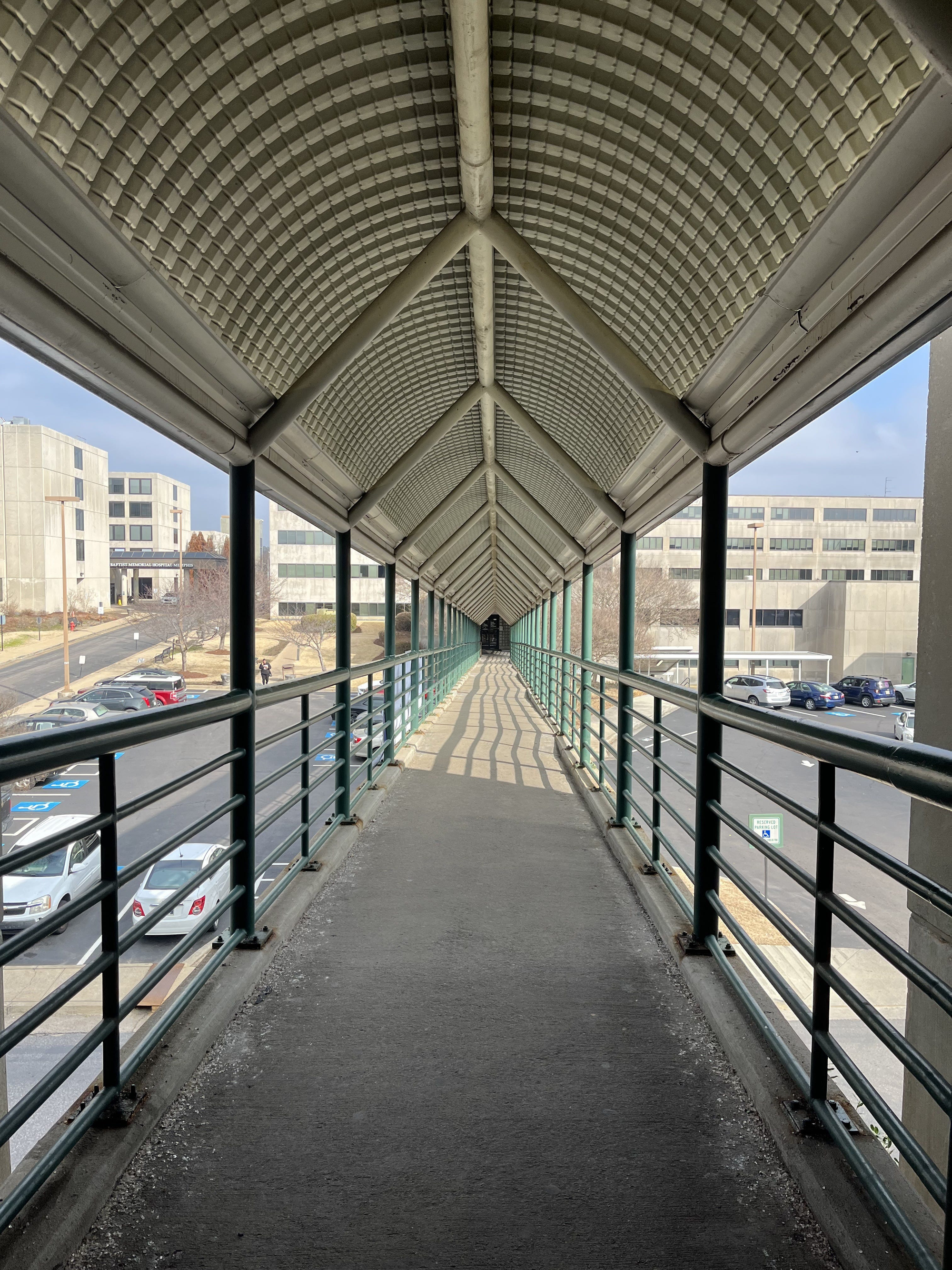
It’s also a walkway. It’s an in-between space. It gets you from where you’ve been (the parking deck) to where you’re going (the hospital). For me, in this moment, it was taking me from where I’ve been, which was a lifetime with my Uncle Joe, to where I’m going, which was the remainder of my life without him. He died in March 2023.
Counseling, in many ways, is a masterclass in liminal spaces.
Parents meet with you to figure out how to tell their daughter about their impending divorce.
A child moves to a new state and has anxiety about making new friends and starting over in school.
A teenager is going to try to come out to her family.
A medical school student didn’t get a match for his internship and has no idea what to do next.
A couple must decide if they can afford fertility treatment after years of trying to get pregnant.
A middle-aged man is attempting a new career.
A new retiree struggles with purpose and contemplates suicide.
An older adult grieves their spouse.
I think it is a very human thing to often feel pulled on one side of this threshold; to feel the pull to retreat to the previous place, all while knowing we can’t stay in what “once was”, or the pull to rush across the threshold as fast as we can. To close our eyes, hold our breath, and hope we can quickly be on the “other side” of whatever is changing.
What is it like to linger in the liminal space? To stay in a place of uncertainty, only knowing for certain that we are headed toward something different?
Grief counseling is a good example of this. Grief is love’s pendulum; where love is great, grief is deep. Many people have said this in a variety of ways and I am paraphrasing them all right now.
I’ll use myself as an example here. After a major loss and a decision to not have any more children, I needed to part ways with baby items taking up storage space in my home. Some days (most days, to be honest) I avoided this task, because I was afraid of the permanence of the change and the grief on the other side of it. It was easier to just somehow step over a stroller in the corner of my guest bedroom, even though it kept me stuck and disorganized. Other days, I purged items as fast as I could without an opportunity to think about what I was doing.
I first called the talk this essay is based on “Anchors in the Thresholds” because that’s the metaphor I imagine for the role of a counselor in liminal spaces. Anchors for the in-between. Counselors provide places to help clients feel a moment of stability as they process what feels impossible to navigate.
How do we become anchors in these spaces?
I have a few ideas. Some of these I’ve learned from working with clients at the thresholds of life and death on how to hold liminal spaces, and some are lessons from my own journey, which started over a decade ago.
Becoming a counselor requires, in the words of Ram Dass, the risk of being human. To be mindful of life, and the certainty that it will one day end. If we can hold onto our understanding of the finiteness of our own limited and liminal time on the earth, how will that change how we spend our time? How we spend our energy? Time becomes the most precious currency of life. To those reading who are counselors, or who are becoming counselors: you have chosen to spend your time: your one wild and precious life, in the words of Mary Oliver, being with vulnerable people in vulnerable places. This is a beautiful risk.
Counseling also requires that you must do what you need to do be present for the work of counseling. What do I mean by that?
I mean you must lean into your own liminal spaces.
I’ll speak for myself here. One of the biggest barriers to what, especially in graduate school, kept me from being able to be fully present — to be able to drop the anchor into uncertainty and fear and grief and pain and all the emotions that can accompany liminal spaces — was perfectionism.
I wanted to get it right. I wanted to say the right things. I wanted to have the best interventions ever to share in supervision. I wanted to be perfect. I said yes to everything.
I don’t think there is anything at all wrong with wanting to do your best work. In fact, I’d say that’s part of what we’re celebrating today. We are celebrating your commitment to the pursuit of excellence in counseling. But I want to be very clear that perfectionism is not excellence. And saying yes to everything gave me some painful life lessons to learn.
Perfectionism is a tool of oppression. It’s something that is demanded in a system of white supremacy, and upholds that destructive system.
Perfection constrains us.
Perfection demands that we only show polished, flawless, outward versions of who we are.
Perfectionism requires us to diminish our humanity.
Perfectionism keeps us right on the edge of the threshold of change, lingering, not able to move forward out of fear of “getting it wrong.”
Perfectionism also rushes us across the liminal spaces, circumventing discomfort and pain and growth.
To me, the most excellent counselors are the ones who share recordings in supervision where they feel like they completely missed the mark. Excellent counselors are the ones who lean into long and deeply held beliefs, the ones who can sit in the discomfort of their own change and growth. They get comfortable with feeling uncomfortable.
As counselors, if our time and energy is spent pursuing perfection, we’ll never be able to enter a liminal space with a client. But if our time is spent pursuing excellence, we’ll have the courage to be imperfect and to learn from mistakes. Alfred Adler said there’s no other way to live.
Excellence is approaching our work with humility and humanity.
Excellence is saying “no.”
Excellence is rest, and restoration.
Excellence is whimsy and play.
Yalom says it’s the relationship that heals. Perfectionism keeps us from true, authentic relationship. Excellence helps us lean in closer.
I think excellent counselors are psychopomps. For my fellow Greek mythology nerds in the house, you know of a few psychopomps such as Charon, Hecate, and Hermes. There’s also my personal favorite psychopomp, Virgil, made famous by Dante Alighieri in the Divine Comedy. These mythological deities are “guides of souls” – that’s what psychopomp means. They are tasked with providing safe passage for mortals from the land of the living to the afterlife. They accompany souls through their journey to the underworld. In Virgil’s case, he walked Dante through hell and back again.
A Psychopomp is also a Jungian archetype: a mediator between the conscious and unconscious, guiding the individual through transformations and transitions.
Psychopomps have a lot in common with excellent counselors. They know how to accompany a soul.
They know the work is to witness, not to fix. They know they can’t walk another soul’s journey for them, but they can walk alongside them. And they know the way though the sacred darkness and depth of transformation.
Psychopomps are comfortable accompanying others on the journey because they’ve made their own descent. Or as we like to say, they’ve “done the work.” Or better said, they’re “doing the work.”
They continually faced discomfort and challenge, and are comfortable lingering in the liminal spaces of life. This is not an easy task.
Friends, the world is harsh and unforgiving. We live in chaotic, turbulent times. I don’t have all the answers, of how to navigate this world, but I believe these deeply in my soul: The greatest thing we can do to not only survive, but thrive, is to live well. The way we can hold a liminal space for others is by creating space within ourselves to fully live.
We can’t be fully alive chasing perfectionism. We can’t be fully alive if we are setting ourselves on fire to keep others warm (shout out to my own counselor, you know who you are).
We’re fully alive when we are lit from within, and it is that inner light that shares warmth to the souls we encounter in our care as counselors. That light is what guides our souls on their journeys, and it helps to light the way for others. We’re fully alive surrounded by a community in pursuit of the greatest good.
I’ll leave you with homework and a quote. Here’s your homework:
One of my favorite theologians Frederick Beuchner once said our calling is the place where our deep gladness and the world’s hunger meet. So I ask you to consider:
1. What makes you fully alive? What is your deep gladness?
2. What brought you here to pursue this work? Where do you see the world’s hunger?3. How are you tending to your inner light?
Look at where those three questions overlap. Therein lies your journey toward excellence as a professional counselor.
I’ll also leave you with one of my favorite lines form the Talmud:
Do not be daunted by the enormity of the world’s grief. Do justly, now. Love mercy, now. Walk humbly now. You are not obligated to complete the work, but neither are you free to abandon it. - Pirkei Avot 2:16
Safe travels, fellow psychopomps.